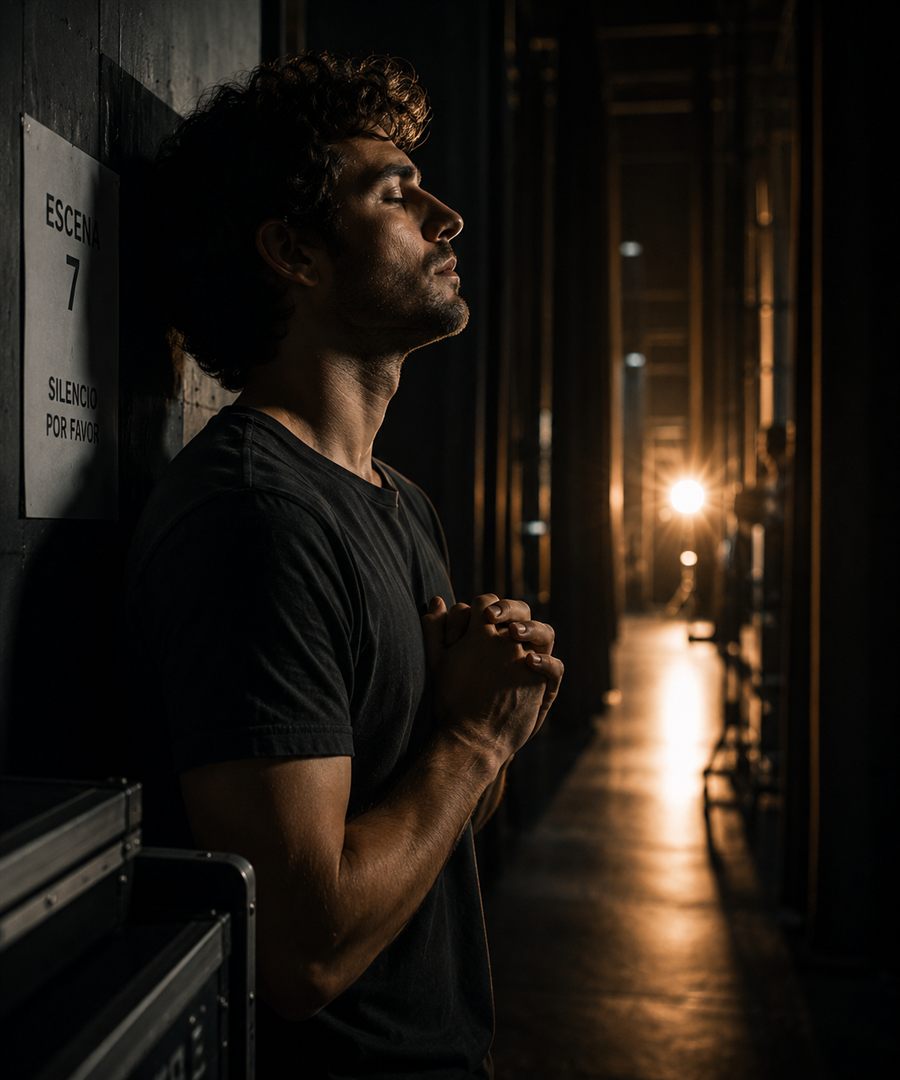
Nerves before an audition are universal. From the newly arrived actor to the veteran with decades of experience, everyone knows that feeling: the knotted stomach, the sweaty palms, the mind that suddenly seems incapable of remembering the lines you've been rehearsing for days. The good news is that nerves are not your enemy. They're energy. And that energy, well channelled, can be exactly what makes your performance memorable.
In this article we gather the most effective techniques — backed by performance psychology and endorsed by professional actors in the Spanish industry — so that you arrive at your next audition in the optimal mental and physical state.
Why we feel nervous: understanding the stress response
Before talking about solutions, it helps to understand the mechanism. When we perceive a high-demand situation, our sympathetic nervous system activates the fight-or-flight response: the heart accelerates, muscles tense, breathing becomes shallow and the prefrontal cortex — the part of the brain responsible for elaborated thinking and memory — reduces its activity. That is precisely why, at the moment we need it most, our lines go blank.
The key is not to eliminate this response but to regulate it. Actors who best manage auditions are not those who feel no nerves; they are the ones who have learned to interpret that physiological activation as enthusiasm, readiness and available energy.
Key insight: Harvard University research showed that telling yourself "I'm excited" rather than "I'm nervous" before a performance objectively improves measurable results. The brain processes both emotions through the same circuits; the difference is merely the label we attach to them.
Preparation is the best medicine against nerves
Audition anxiety tends to grow in inverse proportion to preparation. The more solid your foundation, the smaller the margin for the catastrophe your mind imagines. This involves far more than memorising your lines.
Master the material until it becomes automatic
The goal is not to know the text; it's not having to think about the text. When the dialogue is so internalised that it flows without conscious effort, you free all your attention to listen, react and inhabit the moment. Practise aloud, standing, in motion, in different environments and at different times of day.
Research the project and the casting team
Knowing the tone of the project, the director's filmography or the production company's style gives you confidence and allows you to make well-grounded interpretive decisions. Arrive at the room knowing who will see you and what kind of performance they are likely looking for.
Run mock auditions
Rehearse in conditions as close as possible to the real audition: standing, in similar clothes to what you'll wear, in front of someone acting as a scene partner, within a time limit. The body learns through contextual repetition; if you've already "lived" the situation beforehand, the actual day feels familiar.
Practical tip: Film yourself doing the monologue or scene. Watching the recording makes nearly everyone uncomfortable, but it's the most honest self-awareness tool available. It lets you correct tics, pace, volume and posture before the casting director does.
Breathing techniques for audition day
Breathing is the only autonomic process we can consciously control, and it is the most direct route to regulating the nervous system. These are the techniques most widely used by actors and elite athletes:
4-7-8 breathing
Inhale for 4 seconds, hold for 7 and exhale slowly for 8. Repeat 3–4 times. This technique activates the vagus nerve and engages the parasympathetic nervous system, which directly counteracts the stress response. Use it in the 10–15 minutes before entering the room.
Diaphragmatic breathing
Place one hand on your chest and the other on your abdomen. Inhale so that only the hand on your abdomen moves. Shallow breathing — the kind we do when nervous — activates stress; abdominal breathing switches it off. Practising it for weeks until it becomes automatic is an investment you'll recoup at every audition in your career.
The extended exhale
If you don't have time for full cycles, an emergency solution: exhale for twice as long as you inhale. Simply this — inhale for 3, exhale for 6 — is enough to begin calming the nervous system in under a minute.
Pre-audition routines: what to do in the hours before
Elite athletes have pre-competition rituals because they work. Actors should have them too. A consistent routine tells the brain: "we've done this before, we're ready".
- The night before: Don't rehearse your lines obsessively. Trust the work you've done. Read the material once, calmly, and rest. Sleep consolidates memory.
- The morning of: Eat a proper breakfast — low blood sugar amplifies anxiety. Do some moderate physical movement: a walk, some stretches. Avoid excessive coffee if it over-activates you.
- An hour before: Warm up your voice and body. Humming, lip trills, tongue twisters. Move your body: shakes, neck rotations, jaw stretches. Arrive at the waiting area with enough time so you're not rushing.
- In the waiting room: Avoid compulsively going over your lines. Observe your surroundings, breathe, connect with yourself. If you use headphones, choose music that puts you in the emotional state the character needs — not music that artificially calms you if the role requires intensity.
What you should never do: Compare yourself to the other actors waiting. Each of them is nervous too. Each of them has something different to offer. The waiting room is not a competition; it's the final stretch of your preparation.
What to do if you go blank during the audition
It happens. It has happened to everyone, including actors you now see in top productions. The difference between who recovers and who falls apart lies in how they react in that moment.
Ask for your line naturally
There's nothing wrong with saying: "Sorry, could you give me the cue?" or simply "One moment." Asking for help won't rule you out; losing emotional control might. Casting directors know perfectly well that blanks happen and they value how an actor handles them.
Breathe and return to your body
When the mind blocks, the instinct is to speed up, force, search for the line. Do the opposite: pause for a second, exhale, feel your feet on the floor. The memory is there; sometimes it just needs you to give it space to surface.
Improvise from the character
If the text doesn't come, the character is still there. Improvising from the character's logic — what they want in that moment, what they feel — almost always produces something more interesting than mechanically reciting lines. Some directors value this recovery capacity more than technical perfection.
Don't over-apologise
A brief "sorry" is fine. A cascade of apologies turns a minor slip into the room's protagonist. Recover, carry on and finish strong. What casting directors remember most is the final moment of your performance.
Mental reprogramming: changing the narrative about nerves
Managing performance anxiety in the long term requires working on your internal narrative. Many actors have convinced themselves that nerves mean they're not prepared, not good enough or are going to fail. None of this is true.
Some cognitive psychology tools that work:
- Audition journal: Write down after each audition what went well, what you'd improve and how you felt. Over time you'll see patterns and accumulate genuine evidence that you are capable, beyond the distortions of anxiety.
- Positive visualisation: Spend 5 minutes a day, in the days before an audition, visualising the scene in sensory detail: how the room smells, how your voice sounds, how you feel when you finish. The brain doesn't distinguish well between vivid imagination and real experience; visualisation builds performance memory.
- State anchors: Identify a gesture, word or mental image you associate with a state of calm or confidence. Use it repeatedly in safe contexts until the link is automatic. Before entering the room, activate the anchor.
- Mindfulness: Regular mindfulness meditation demonstrably reduces stress reactivity. You don't need an hour a day; ten minutes of attention to the breath, five days a week, produces measurable changes within a few weeks.
Professional perspective: Many established Spanish film actors describe nerves in almost affectionate terms: "a sign that it matters to me", "energy I need", "proof that I'm alive on stage". Changing your relationship with nerves, rather than eliminating them, is the real goal.
When nerves signal something more: chronic performance anxiety
There is a difference between the normal nerves of an audition — regulated by the techniques described — and chronic performance anxiety, which systematically interferes with your professional and personal life. If nerves prevent you from attending auditions you want, if the discomfort persists long after the performance ends, or if it affects your sleep, eating or relationships, it may be helpful to work with a psychologist specialising in performance or performing arts.
Cognitive behavioural therapy (CBT) has very well-documented effectiveness for performance anxiety. Seeking professional support is not a sign of weakness; it's exactly the same as taking acting classes — investing in your instrument.
Your profile, always ready when the opportunity comes
Create your professional profile on Arga Studios and arrive at every casting with all your information and materials up to date. Free until October 2026.
Create my free profile →