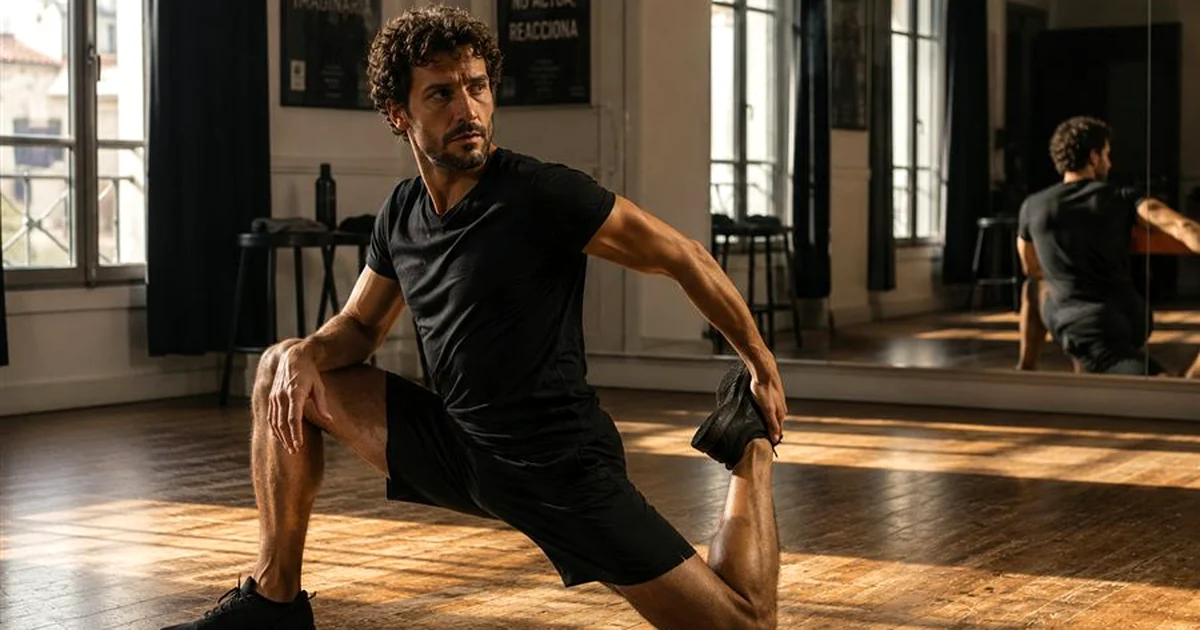
A musician looks after their instrument. They tune it, maintain it, devote hours of daily practice to it even when there is no concert on the horizon. An athlete trains their body with a systematic plan that does not stop between competitions. The actor, however, often treats their instrument —their body— as something secondary to text work, voice or dramaturgical analysis. This is one of the most widespread limitations in actor training.
The body is not the actor's vehicle. The body is the actor. Everything that happens in a performance —emotion, thought, presence, energy— happens through the body and is inseparable from it. A rigid body, without awareness, without availability, limits what the actor can do even if their inner work is brilliant.
The teaching traditions that put the body at the centre
The great teaching traditions of twentieth-century theatre understood this well: body work is not a decorative add-on to actor training but its foundation.
Jacques Lecoq and the neutral mask
The French teacher Jacques Lecoq developed in Paris one of the most influential actor-training systems of the twentieth century, based on movement, observation and physical improvisation. His best-known tool is the neutral mask: a full-face, expressionless mask which, by covering the actor's face, removes facial expressiveness as a resource and forces the whole body to communicate. Working with the neutral mask reveals with brutal clarity which parts of the body are available and which are blocked or disconnected.
Lecoq's pedagogy starts from the idea that every emotion, every situation, every element of the natural world has a dynamic that the actor can discover with the body before translating it into words. An actor trained in this tradition has a capacity for physical invention that is rarely acquired through voice and text analysis alone.
Meyerhold's biomechanics
The Russian director Vsevolod Meyerhold developed in the early twentieth century an actor-training system called biomechanics, inspired by industrial Taylorism and by the traditions of Eastern mask theatre. Biomechanics proposes that emotion in the actor is generated through physical movement, not the other way round: if the actor precisely executes the correct sequence of movements, emotion appears organically.
Although the debate between the "inside-out" approach (Stanislavski) and the "outside-in" approach (Meyerhold) is one of the most productive in actor pedagogy, in practice the two are complementary. An actor who works only from the inside often has a body that does not express what they feel; one who works only from the outside may come across as efficient but empty.
The Alexander technique
Developed by the Australian actor Frederick Matthias Alexander in the late nineteenth century, the Alexander technique focuses on the relationship between the head, the neck and the spine, and on how habitual patterns of tension in that central axis affect the functioning of the whole body. Its fundamental principle is inhibition: the ability to pause the habitual automatic response before acting, creating space for a freer and more conscious response.
For actors, the Alexander technique is especially useful for eliminating chronic tensions that block the voice, movement and emotional availability. Most of the great drama schools of the English-speaking world include it in their curriculum.
Physical disciplines useful for the actor
Beyond specifically theatrical methods, there are physical disciplines with high transfer value for acting practice. Not all of them work the same way for everyone; the key is to find the ones that challenge you in your areas of least availability.
Yoga
Yoga combines flexibility, strength, breathing and concentration work. For the actor, its greatest contribution is body awareness in the present moment: the ability to perceive one's own body precisely, to sense where there is tension, where there is openness, where there is blockage. The breathing work of yoga —especially pranayama— also transfers directly to vocal control and the management of emotional state.
Pilates
Pilates develops the strength of the body's centre —the core— and improves postural alignment. An actor with a strong centre has greater physical stability on stage, can move with more control and precision, and has a lower risk of injury in physically demanding productions. The alignment awareness that Pilates develops is also valuable for the voice: a well-aligned spine allows for fuller vocal resonance.
Dance
Any form of dance —contemporary, classical, flamenco, dance-theatre— develops in the actor the ability to inhabit time and space with intention. Dance teaches rhythm, coordination, use of weight, relationship to space and to other bodies, and —in its more expressive forms— the ability to communicate inner states through pure movement. You do not need to become a dancer; even a year of regular contemporary dance classes transforms an actor's physical availability.
Martial arts
Martial arts —especially those of Eastern origin such as tai chi, aikido or kung fu— develop presence, centring, coordination, energy management and spatial awareness. Tai chi in particular, with its emphasis on slowness and precision, is a powerful tool for the actor who needs to develop stage presence without tension. Many physical-theatre companies include martial-arts training as part of their regular practice.
The Feldenkrais method
Developed by the physicist and engineer Moshe Feldenkrais, this method works through very small, slow movements to reprogram the nervous system and create new movement options. It is especially useful for actors who have deeply ingrained postural or movement habits that limit their expressive availability. Unlike other disciplines, Feldenkrais requires no physical effort; it works with attention and the gentle exploration of movement.
Training principle: You do not need to master all these disciplines. It is better to choose one or two that genuinely challenge you and practise them regularly for at least a year than to try many things superficially. Depth, not variety, is what transforms the instrument.
How physical preparation changes the quality of performance
Let casting directors find you
Your talent needs visibility. Create your professional profile on Arga Studios and show up in the searches of those who hire. Free until October 2026.
Create my profile for free →The effect of body work on acting is not metaphorical. It is technical and measurable in everyday practice. These are the most concrete transformations that actors with regular physical training report:
- Greater emotional availability: A body without chronic tension is a body more porous to emotion. Habitual tensions literally function as armour that hinders access to real emotional states.
- More intense stage presence: Presence is no mystery: it is the result of completely inhabiting one's own body in space, without dissociation between what is thought and what is done physically.
- Greater physical and expressive range: A trained body can do more things, faster and with more precision. It can go from absolute stillness to explosive action with no visible preparation. It can inhabit different centres of gravity, different relationships with weight, radically different movement styles.
- Better voice: The voice is inseparable from the body. Tension in the neck, shoulders, chest and abdomen directly affects vocal resonance, projection and fluency. A freer body produces a freer voice.
- Stamina and energy on stage: Theatre productions and shoots are physically demanding. An actor in good physical condition can maintain the quality of their performance through hours of rehearsal or filming, whereas one without training suffers a visible degradation of their energy and presence as the day goes on.
Physical demands by specialism
An actor's physical demands vary enormously depending on the type of work. Knowing the specific demands of your main field lets you direct your training more efficiently.
Theatre
Theatre demands physical and vocal stamina to maintain energy and presence over performances of two hours or more, sometimes with only one interval and with a matinée and an evening show on the same day. Physical-theatre or movement productions add demands of strength, coordination and acrobatics. Regular cardiovascular training —swimming, running, cycling— combined with yoga or Pilates forms a solid base for theatre actors.
Film and television
A shoot is different: days of waiting interspersed with moments of high intensity, possible action scenes or specific physicality, sometimes filming in extreme conditions (cold, heat, rain). The main demand is not the stamina of a complete performance but the ability to be available and present at any moment, after hours of waiting, and to maintain that availability take after take. Mindfulness training and the management of physical state —knowing how to rest and how to activate as needed— is especially valuable here.
Musicals
Musicals are the most physically demanding specialism: the actor must sing, act and dance simultaneously, often for more than two hours, with performances up to six days a week. Cardiovascular condition, leg and core strength, rhythmic coordination and vocal stamina are all essential. Actors who work regularly in musicals tend to have training routines similar to those of professional dancers.
On injuries: The acting profession has a higher injury rate than most people imagine. Physical work without an adequate technical base —especially in productions with acrobatic or stage-combat demands— is the main cause. Having regular physical training does not only improve your acting: it also protects you. An injured actor cannot work.
A basic physical-training plan for actors
You do not need to become a professional athlete. You need an available, conscious instrument free of chronic tension. Here is a realistic weekly framework for an actor with no production in progress:
- 2-3 sessions of specific body work: yoga, Pilates, Alexander technique or Feldenkrais. These sessions work on awareness, alignment and availability.
- 1-2 sessions of moderate cardiovascular training: swimming, gentle running, cycling. This maintains stamina and overall energy without overloading the body.
- 1 session of dance, martial arts or expressive movement: this works on coordination, rhythm, and the relationship to space and other bodies.
- A daily 15-20 minute vocal and physical warm-up: even when there is no rehearsal. This daily habit —stretching, breathing, voice— keeps the instrument available and develops baseline awareness.
During productions, the plan adapts to the demands of the work. The essential thing is not to abandon the upkeep of the instrument during periods without work: "acting condition" —that specific physical, vocal and energetic availability— is lost to a sedentary lifestyle and recovered only slowly.
The actors with the greatest longevity in the profession are almost invariably those who treat their body as an asset requiring constant care, not as something that "is already there" and needs no attention. The instrument is played every day, even when there is no show.
Build a solid career from the start
Create your profile on Arga Studios and access castings, connect with professionals and manage your acting career from a single place.
Create my profile for free →