The self-tape has become the dominant form of auditioning in Spain and across the entire audiovisual industry. Since the 2020 pandemic, the majority of castings — even for major productions — begin with a self-tape. Knowing how to record one well is now a professional skill as important as acting itself.
What is a self-tape and when is it used
A self-tape is a video recording made by the actor at home using a script excerpt provided by the casting team. It is sent to the casting director, who reviews it alongside other actors to make a shortlist before the in-room audition.
It is used mainly for:
- First-round castings for series and film.
- Castings for actors who are not in the same city as the team.
- International productions selecting actors across several countries simultaneously.
- Urgent castings where there is no time to call everyone in.
The kit: what you need (and what you don't)
You do not need a professional camera. You need:
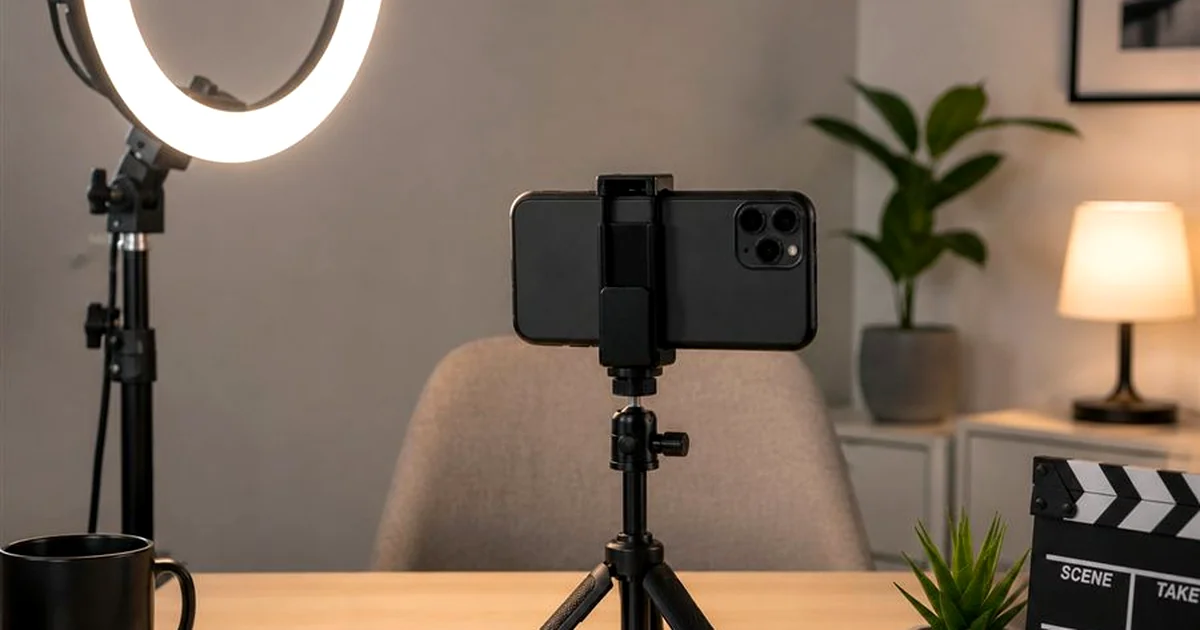
- A modern smartphone. A recent iPhone or Android records in 4K with more than sufficient quality. Record in landscape mode, never portrait.
- A tripod or stable mount. Handheld camera wobbles. A cheap tripod (10–20€) is essential. The camera should be at eye level.
- A lapel microphone. Audio is the number-one factor. A wired lapel mic (15–30€) dramatically improves sound quality over the phone's built-in microphone. Wireless lapel mics for smartphones (Rode Wireless ME, DJI Mic) are the premium option.
- Basic lighting. A soft light source in front of you. Natural light from a side window is perfect. An affordable ring light (15–30€) also works well.
- A neutral background. A plain, light-coloured or grey wall. No distracting décor.
Framing: how to position yourself in the shot
The standard self-tape framing is the American shot: from the head to mid-thigh. Centre your head in the upper portion of the frame, leaving a little space above (headroom). Not too close (context is lost) and not too far (facial expression is lost).
Important: look at a point slightly off-camera (to one side of the lens), not directly into the lens, unless the casting instructions say otherwise. That point is where the "other actor" is: place it at the camera's eye level, not on the floor or the ceiling.
The most common framing mistake: Looking directly into the camera lens when there is dialogue with another character. Reserve direct eye contact with the camera for when the character is alone or the script indicates a moment of direct confidence with the audience.
Lighting: the window rule
The best free lighting is natural light from a side window. Position yourself facing 45 degrees from the window: the light illuminates one side of your face, creating natural volume without harsh shadows.
Avoid: direct overhead light (creates unflattering shadows under the eyes), light behind you (turns you into a silhouette), and direct frontal light without diffusion (flattens the image).
If you need to record at night, a ring light placed in front of you at eye level produces a clean, professional result.
Sound: the most important factor
A casting with mediocre image but good sound gets watched. One with perfect image but poor sound does not. Casting directors listen to performances, not just watch them. If the audio crackles, echoes, or picks up outside noise, your work is lost.
Tips:
- Record in the quietest spot in your home.
- Close the windows before recording.
- Rooms with clothes, books, and furniture have less echo than empty ones.
- Do a 10-second test recording and listen back on headphones before you start.
The text reader (the "feeder")
In a self-tape, there is normally a person who reads the other character's lines off-camera (the "feeder"). If no one is available, record yourself reading the other character's lines first, then act against that recording. You can also use a teleprompter app for the other character's text.
The person feeding lines should read the text without acting — neutrally — so that your performance does not depend on the feeder's tone.
Performance in a self-tape: less is more
The camera amplifies everything. An emotion that requires a broad gesture on stage communicates through a micro facial movement on a self-tape. Actors recording their first self-tape tend to over-act. The work is to reduce, concentrate, internalise.
Also: begin each take with the character already in the emotional state of the scene, not arriving at that state during the take. Casting directors watch many self-tapes: the first three seconds determine their level of attention.
Submission format and labelling
- Format: MP4, minimum resolution 1080p.
- File name: FirstName_LastName_Character_Title.mp4
- If the casting asks for multiple scenes, send them as separate, clearly labelled files.
- Upload to WeTransfer, Google Drive, or Vimeo (do not share directly from your phone's camera roll).
- Check the link works before sending it.
Apply to self-tape castings via Arga Studios
Create your profile and access castings across Spain that accept self-tape applications.
View castings →