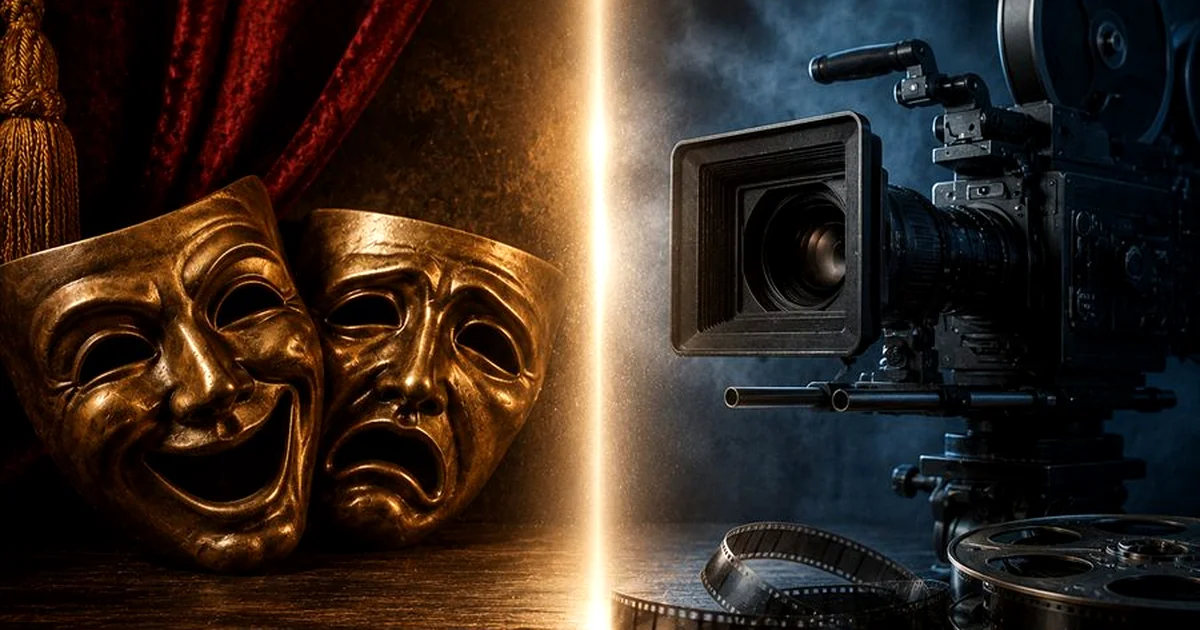
The move from stage to screen is one of the most common journeys in a Spanish actor's career. Many trained in the theatre find themselves in front of the camera with the feeling that they are "doing too much": projecting toward the back of a room that doesn't exist, gesturing more than the lens needs, speaking to an audience that isn't there. This article explains the technical differences and how to adapt.
The fundamental difference: the distance to the viewer
In theatre, the nearest spectator is several metres away. Facial expression, gesture, voice: everything needs to be projected. In film, the camera can be 30 centimetres from your face. The close-up captures what no theatre spectator ever sees: thought itself.
This doesn't mean you have to "do less". It means doing it differently: the internal processes that in theatre must be expressed physically to be read are conveyed on camera with the actor doing nothing more than genuinely thinking them.
Active listening on camera
In theatre, active listening is a skill. In film, it is the most important skill. A stage actor may be used to marking the moment of listening in a visible way; on camera, that comes across as overacting. The camera detects whether you are really listening or just waiting for your turn to speak.
Exercise: rehearse scenes by recording yourself and mute your own volume when you review. Just watch your face while the other character speaks. Are you present, or are you "switched off"?
The voice: from projection to truth
The stage voice is a tool of projection. The film voice is a tool of truth. An actor used to the theatre tends to speak "toward the audience" even when there is no audience. On camera, this sounds artificial right away.
- Deliberately lower the volume in the first rehearsals until the director asks for more.
- Work the voice at the level of real conversation, not of a scene.
- The microphone picks up everything: whispers, breaths, genuine hesitations.
Working with marks and continuity
Let casting directors find you
Your talent needs visibility. Create your professional profile on Arga Studios and show up in the searches of those who hire. Free until October 2026.
Create my free profile →In film there are exact positions where you must stand so that focus, lighting and framing work. Learning to "hit your mark" without looking like you are hitting your mark is a specific skill that develops with practice.
Continuity is another element with no equivalent in theatre: if in take 1 you pick up the glass with your right hand, in take 2 you must pick it up with the same hand. The script supervisor keeps track, but the actor has to be aware of their own movement patterns.
The discontinuous rhythm of the shoot
Theatre has a dramatic arc that the actor travels from beginning to end. Film is shot in fragments, often out of chronological order. The final scene may be shot on the first day. The emotional opening-up that in theatre you build over two hours, in film you have to switch on on demand, cold, after waiting two hours at the catering table.
The stage actors who make the transition best master the quick warm-up: a pre-action ritual that activates the character's emotional state in minutes, regardless of whatever happened before.
Practical tip: If you come from the theatre and you're called for a screen test, shoot a self-test first: record a close-up scene at home and watch what your face, your voice and your body do when there is no room to fill. What you see is your real starting point.
What theatre gives you for film
Theatre training is not an obstacle to film: it is a foundation. Stage actors bring with them command of the text, physical presence, the ability to work live without a safety net and an understanding of dramatic structure. None of those things go to waste in film. The only thing to adjust is the scale and the channel of expression.
Create your actor profile on Arga Studios
Connect with casting directors for film, series and theatre across Spain. Free until October 2026.
Create my free profile →