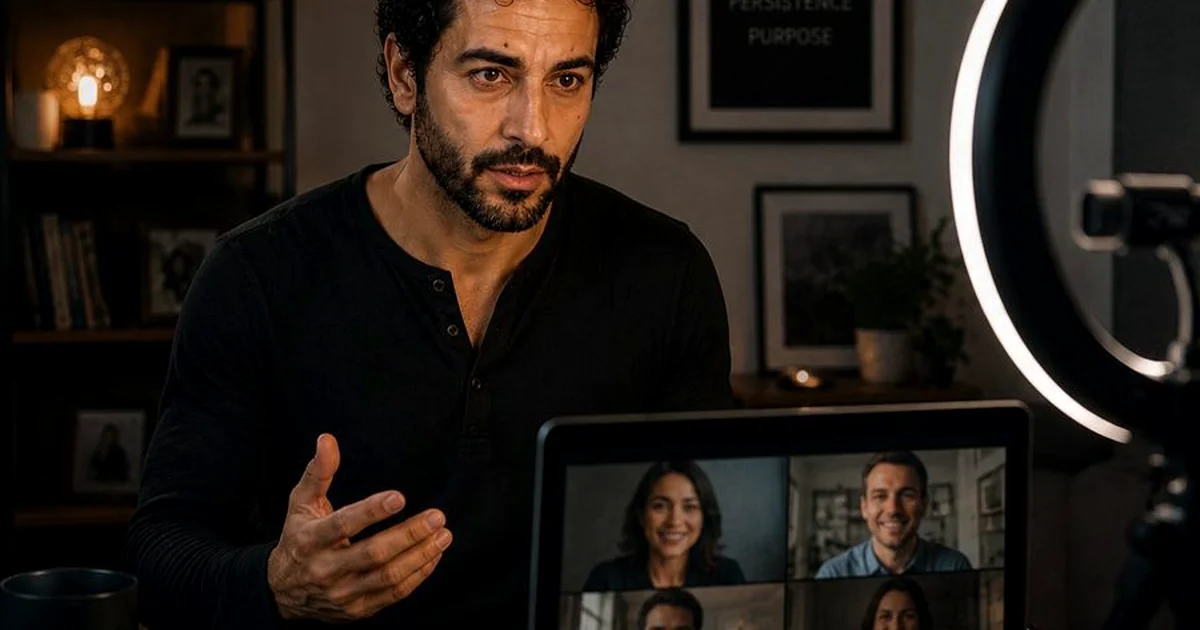
Online castings have become a permanent part of the selection process in Spain. They are not a lesser substitute for the in-person audition: they are a different format with their own rules. Actors who understand those rules have a real advantage over those who show up to a video call as if it were an in-room reading.
The reality of online casting in Spain
National production companies and casting agencies use online formats mainly for: first selection rounds, castings of actors who are not in the same city, and productions on a tight budget. It is not unusual for an actor from Barcelona to do a first online test for a Madrid production, with the in-person audition only coming if they pass the filter.
The most common process is the self-tape (a recording sent in advance), but there are also live castings over Zoom, Google Meet or specialised platforms. This guide covers both formats.
Technical setup: what you can't improvise
An excellent performance ruined by poor image or audio quality won't reach the decision-makers. Technical setup is not an extra: it's the minimum required for your work to be seen.
The camera
The camera of a modern smartphone (iPhone 11, Samsung Galaxy S20 or equivalents onwards) is enough for an online casting. What matters is not the camera but how you use it:
- Place it at eye level, never looking up from a low table. A low angle distorts the face and gives an unflattering image.
- Rest it on a tripod or stand, never in your hand. Shaking makes it impossible to assess the performance.
- Use the rear camera for self-tapes: it has better resolution than the front one on almost every model.
- Shoot horizontally, in 16:9 format.
The audio
Bad audio is more destructive than a bad image. In online castings, the director needs to hear your voice clearly.
- Record in the quietest room you have. Close windows, turn off fans and fridges if possible.
- A basic external microphone (a €20-30 lavalier) noticeably improves the audio compared to the phone's built-in microphone.
- Avoid rooms with echo (tiles, bare walls). A bedroom with clothes is a natural recording studio.
The lighting
The simplest light that works: a large window to your side (natural side light). If you record at night or have no access to natural light, a €30-40 LED ring light placed in front of you at eye level gives professional results.
What you should avoid:
- A window behind you: your face will be in shadow.
- Ceiling light alone: it creates harsh shadows in the eyes.
- Mixing cool and warm light in the same shot.
The right framing
The standard shot for an actor's casting is the chest shot or medium close-up: the face, neck and shoulders down to the chest are visible. Leave a small space of "headroom" above the head, but not too much.
The background should be neutral and free of distractions. A plain wall, preferably in a colour that doesn't clash with your skin tone. Avoid virtual backgrounds in castings: they give an artificial look that doesn't help.
Continuity tip: If you are going to record several scenes or several takes on the same day, keep the same clothing, lighting and framing. Abrupt changes between scenes signal a lack of professionalism.
On-screen presence: acting for the camera
Let casting directors find you
Your talent needs visibility. Create your professional profile on Arga Studios and appear in the searches of those who hire. Free until October 2026.
Create my free profile →The biggest mistake in online castings is acting for an imaginary room. The camera captures everything: micro-gestures, breathing, the character's thoughts. What requires projection on stage requires restraint on camera.
Key points for on-screen presence:
- Look at the camera, not the screen in live video calls. Real eye contact is created by looking at the lens, even if it feels counter-intuitive.
- In self-tapes, the gaze depends on the scene: it can go slightly to the side of the camera (where the other character would be) or straight at the lens if the character is addressing the viewer.
- Reduce abrupt head movements: the camera amplifies them.
- Speak with clear vocal energy: video-call compression flattens the nuances of the voice.
Before you connect: the protocol
For a live casting video call:
- Test the connection, audio and camera 30 minutes beforehand.
- Close all unnecessary applications on the computer.
- Connect 5 minutes before the scheduled time.
- Have the text ready: on a sheet of paper outside the frame if you need support.
- Let the people you live with know, to avoid interruptions.
Differences with the self-tape
The self-tape gives you total control: you can repeat as many times as you want and send the best take. This is both an advantage and a trap. Actors who do 40 takes chasing the perfect one usually send something over-rehearsed that loses its freshness.
A reasonable protocol for the self-tape: 3-5 warm-up takes you don't send, and then 2-3 takes "for real". Send the second or third, not the first or the tenth.
Show up in the castings looking for your profile
Create your profile on Arga Studios and access film, series and advertising calls across Spain. Free until October 2026.
Create my free profile →