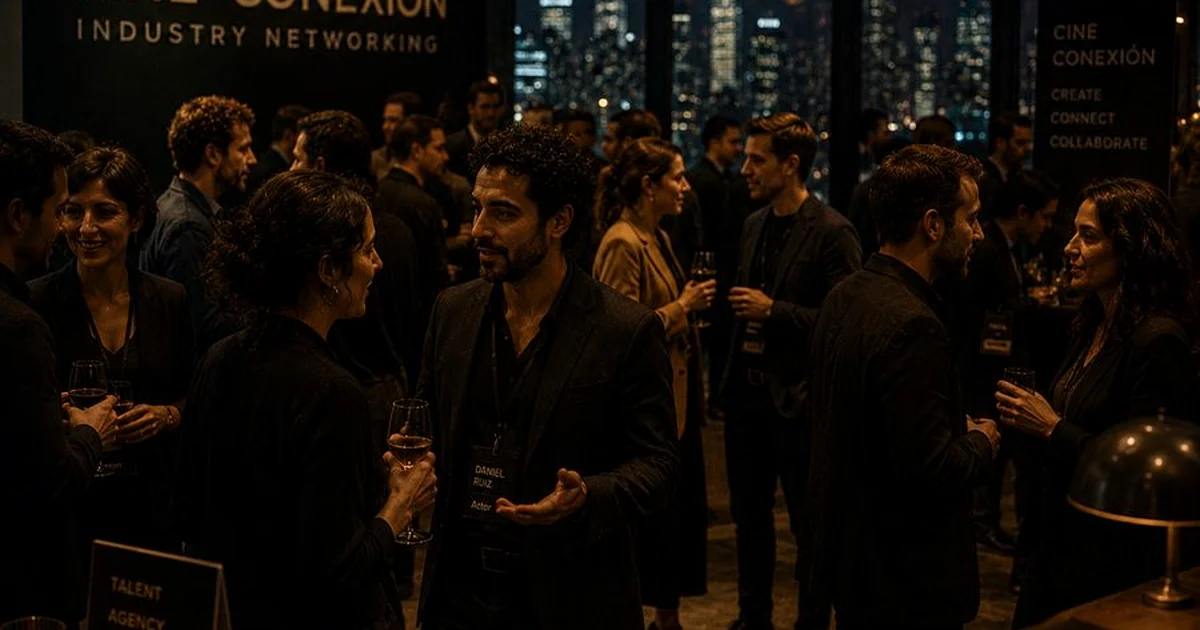
The film and theatre industry runs, to a very significant degree, on relationships. Not on favouritism —although nepotism exists and it would be naive to deny it—, but because in a sector where projects are complex, deadlines tight and trust a scarce asset, directors, producers and casting directors tend to turn first to the people they know, whom they have seen work or about whom they have references from someone they trust. Talent is the foundation. Relationships are the multiplier.
This article is not about networking understood as handing out business cards or mechanically attending events. It is about how to build genuine professional relationships —ones that add value to both parties and last over time— in the Spanish audiovisual and performing-arts industry. There is an enormous difference between knowing someone and having a relationship, and that difference is built with time, attention and judgement.
Why misunderstood networking doesn't work
Before talking about strategies, it's worth dismantling the myth of transactional networking: the idea that going to an event, approaching the person who interests you and introducing yourself in the hope of being called for a casting is an effective strategy. It rarely is.
Industry professionals —directors, producers, casting directors, agents— constantly receive requests for attention from actors. They learn very quickly to tell the difference between someone who wants something from them right now and someone who is genuinely interested in what they do. The first attitude closes doors; the second opens them slowly, but keeps them open for a long time.
Networking that works starts from a different question: not "how can I get hired?", but "how can I add value to this person and to this ecosystem?". The answer to that question generates relationships that, over time, produce work opportunities.
Film festivals: the industry's natural space
Film festivals are the great networking events of the Spanish audiovisual industry. Not only because they bring together professionals from across the sector, but because they do so in a relaxed context oriented towards enjoyment and discovery, where interaction is natural and welcome. Attending festivals as an active spectator —watching films, taking part in Q&A sessions, going to fringe activities— is one of the most profitable investments an actor can make in their career.
San Sebastián International Film Festival
The most prestigious in the country and one of the most important in Europe. Every September, San Sebastián gathers directors, producers, distributors, agents and journalists from all over Spain and internationally for ten days. For an actor who wants to build relationships in auteur cinema and quality production, the Official Selection, the Horizontes Latinos section and the Industry Meetings (where professional meetings between projects and financiers take place) are the most relevant spaces.
Málaga Festival. Spanish-Language Cinema
The benchmark festival for Spanish and Ibero-American cinema. Held every spring, Málaga has a more local focus than San Sebastián and is, for that reason, particularly valuable for actors looking to break into the contemporary Spanish industry. The Q&A sessions with directors, the presentations of projects in development and the short-film section are ideal contexts for making contacts.
Sitges Festival
Specialising in fantasy, horror and genre cinema, Sitges is the most relevant festival for actors interested in that market segment —which in Spain has an increasingly active output—. Its fringe activities include masterclasses and meetings with emerging directors who are precisely in the phase of building their regular team.
D'A Film Festival (Barcelona) and Atlàntida Mallorca Film Fest
Medium-sized festivals but with high-quality programming and a community of professionals that is more accessible for those just starting to build their network. At smaller festivals, the ratio between professionals available to chat and attendees seeking them out is more favourable.
How to make the most of a festival: Before attending, research which films will be screened, who the directors and producers present will be and which fringe activities have content relevant to you. Go with genuine curiosity —to watch films, to hear their creators—, not with a contacts agenda. The most fruitful conversations happen spontaneously after a screening, in a queue or in a discussion gathering.
Industry events: beyond the festivals
The Spanish audiovisual industry generates an ongoing schedule of professional events that many actors are unaware of or do not attend. These are spaces where working professionals gather and where the exchange of information and the creation of bonds happens naturally.
- Series and film presentations and premieres: Premieres with a Q&A or team presentation are moments when established directors and actors are accessible in an informal context. Regularly attending the kind of projects that interest you places you in the orbit of the people who make them.
- Directors' masterclasses and workshops: Several institutions —the Film Academy, cultural centres, the Seminci in Valladolid, the Escola de Cinema de Catalunya— regularly organise workshops given by working directors. Attending these workshops as a participant or even as an observer is a way to learn and to be present.
- Meetings of the Academy of Motion Picture Arts and Sciences: The Academy organises screenings, debates and events throughout the year. Although access is not always free, there are public events that allow you to stay in touch with the professional community of Spanish cinema.
- Staged readings and presentations of theatre projects: Theatre has its own schedule of open events: readings, season presentations, post-performance gatherings. They are excellent contexts for meeting stage directors and playwrights.
Film and theatre schools as a network
Let casting directors find you
Your talent needs visibility. Create your professional profile on Arga Studios and show up in the searches of those who hire. Free until October 2026.
Create my profile for free →One of the most underrated assets of having attended a good acting school or having taken part in academic film projects is the network generated in that context. The directors, screenwriters and producers who are emerging today —and who will be established tomorrow— also passed through those schools. The relationships formed while everyone is learning and without career pressures are often the most lasting and genuine.
If you have the chance to collaborate on film-school graduation projects, to take part in intensive workshops that mix actors with directors in training, or to attend screenings of film-school work, do it. You are investing in relationships that will take years to bear fruit, but when they do, they will do so in the context of trust built from the very beginning.
Social media: a real presence, not a shop window
Instagram, LinkedIn and, to a lesser extent, X (Twitter) are networking tools for actors when used intelligently. The key is to understand what each platform is for and what kind of presence generates relationships rather than simply visibility.
Instagram: the Spanish creative sector's network
Instagram is the network where professionals from the Spanish audiovisual and theatre sector are most active. A well-maintained professional profile —with work material, reflections on the craft, cultural references that show your world— works as a permanent business card. But what turns visibility into a relationship is genuine interaction: commenting on the work of directors and peers with something worth saying, sharing other people's projects when they move you, taking part in industry conversations with your own voice.
LinkedIn: the forgotten professional
Many actors ignore LinkedIn because they associate it with the corporate world. Mistake. It is the platform where producers, casting directors with a more business-oriented profile and the communications managers of production and distribution companies are most present. An up-to-date LinkedIn profile, with your credits, your training and an introduction video, makes you visible in searches that would otherwise never reach you.
What doesn't work on social media
Sending direct messages to directors or casting directors asking for work. Commenting on professionals' posts with messages that are clearly requests for attention. Posting content that turns your profile into a reel of performances with no context or personality. The rule is simple: social media is for showing who you are, not for asking for things.
Social media strategy for actors: Choose one or two platforms and work them well rather than having a mediocre presence everywhere. Post at a sustainable frequency and with content that genuinely reflects your perspective on the craft and on culture. Interact authentically. Over time, the people whose work you follow attentively will recognise you when you meet in person.
How to approach a contact without coming across as invasive
The moment of approaching someone in the industry —a director you admire, a casting director whose work you follow— is the one most actors handle badly. The most frequent mistake is going straight in to ask for something (a meeting, an audition, to be kept in mind) without having built any prior relationship foundation.
The approach that works looks much more like a conversation than a request:
- Start with that person's work, not your own. If you have just seen their film or show and something in it genuinely moved you, tell them so. Precisely, with something specific that shows you have really seen it. Not a generic "I loved your film"; something concrete that only someone who watched it attentively could say.
- Don't turn the first contact into a request. If the first message you send or the first words you say in person are a request for work or a meeting, you have burned the relationship before starting it. Let the contact grow before asking for anything.
- Be memorable for the right reasons. The person who asks intelligent questions in a Q&A, who has an informed opinion about a director's work, who contributes something to the conversation —that person is remembered. The actor who introduces themselves with their card and says "I'd like to work with you" is not.
- Follow up, with moderation. If you had a brief but real conversation with someone relevant, a short message a few days later ("it was a pleasure to meet you, I'm still thinking about what you said about X") keeps the connection alive without being invasive. Aggressive persistence closes doors; warm, occasional follow-up keeps them ajar.
Building long-term relationships
The professional relationships that have the most impact on an acting career are the ones built over years, not those forged in a single night of networking. This calls for an attitude of patience and consistency that runs against the urgency most actors feel at the start of their career.
Some concrete practices for cultivating long-term relationships:
- Go and see the work of your contacts. If a director you've crossed paths with premieres a project, go and see it and let them know you went. Not as a strategy, but because that is how genuine connections stay alive.
- Give without expecting an immediate return. Recommend other actors when you can't take on a project. Share opportunities with your peers. Be generous with information. The industry has a long memory and generous people build a good reputation.
- Stay in touch in the good moments, not only when you need something. A sincere congratulation when someone wins an award, finishes a production or announces a new project is a small gesture with a disproportionate relationship-building effect.
- Look after your relationships with peers as much as with those who hold more power. Today's assistant director is tomorrow's director. The actress starting out at the same time as you may be the one who recommends you for a role ten years from now. The horizontal network —among peers— is as valuable as the vertical one.
Start by having the best profile in the room
Create your professional profile on Arga Studios and make sure that when someone is looking for actors for their project, you show up. Free until October 2026.
Create my profile for free →