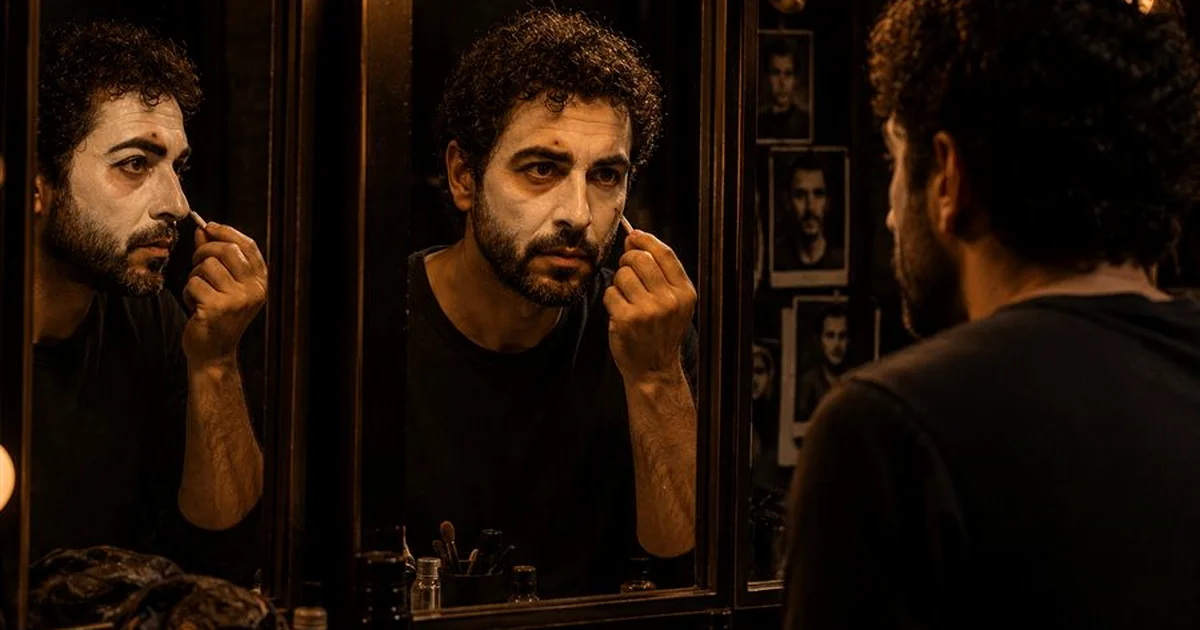
Building a character is one of the most fascinating and most baffling processes in the actor's craft. There is no single way to do it —every actor, every school and every tradition has its own path—, but there is a working structure that lets you move forward in an orderly way, from the first pages of the script to the moment when the character inhabits your body naturally, with no visible effort.
This article gathers a complete and practical methodology, blending Stanislavski's contributions to inner work with the physical tools of the Laban system for movement, and adding the steps that contemporary professional actors have proven to work in real practice, whether for film, television or theatre.
Step 1: The character's biography
Every character has a life before the script or the play begins. That life does not appear in the text but it shapes it completely: how they speak, how they move, what they fear, what they desire, how they react to conflict. Building your character's biography is the foundational act of the whole process.
Stanislavski insisted that the actor must know their character better than the author: knowing what happened in their childhood, what the first great loss of their life was, what experience changed the way they see the world. You don't need to write a novel, but you do need to have clear answers to the fundamental questions:
- Where were they born and in what family context did they grow up?
- What was the most decisive event of their childhood?
- What is their relationship with money, power, love, death?
- What is their greatest fear and what is their deepest shame?
- What happened the day before the story begins?
- What does the character dream of for their future? What do they believe they deserve?
The answers that aren't in the script you invent yourself, but they must be consistent with what is written. The biography is not free fantasy; it is a logical and sensitive extension of the text.
Step 2: Physical life and the body centre
Rudolf Laban, the Hungarian choreographer and movement theorist, developed in the 20th century a system of movement analysis —known as Laban Movement Analysis (LMA)— that actors have adopted as a tool for building physical characters. The premise is simple and powerful: each character has a relationship with space, time, weight and flow that is uniquely their own, and that relationship shows in how they move, where they place their weight, how they use their hands, how they occupy the space around them.
The centre of gravity
One of the most useful exercises in Laban work for actors is to identify the character's centre of gravity: the part of the body that "leads" their movement. A dominant character might lead from the chest; an anxious character from the neck and chin; a sensual character from the pelvis; an intellectual character from the head. Try walking through the space, letting different parts of your body take the initiative, and watch what kind of person emerges.
The qualities of movement
Laban identified four factors of movement that determine the quality of any action: weight (strong/light), space (direct/indirect), time (sudden/sustained) and flow (bound/free). A military character might combine strong weight, direct space, sudden time and bound flow. An artistic character might be light, indirect, sustained and free. Experiment with these combinations to find your character's physicality.
Body exercise: Walk around the room for ten minutes, systematically varying the four Laban qualities. When you find a combination that feels strange, uncomfortable or completely new to you, that may be where your character's physicality lies. What moves away from your own natural pattern is what transforms you the most.
Step 3: The psychological centre and the animal image
Michael Chekhov —the playwright's nephew, an actor trained with Stanislavski and a teacher of actors such as Marilyn Monroe, Clint Eastwood and Ingrid Bergman— developed the concept of the psychological centre: the place in the body from which the character's psychic energy radiates. Unlike the Laban physical centre, the psychological centre is metaphorical and works as an image that organises the character's inner world around an energetic sensation.
A very useful complementary exercise is the animal image: what animal is your character? Not in the literal sense, but in the sense of which animal shares their energy, their way of relating to the environment, their way of occupying space and of reacting to threat. A character might be a hawk —speed, precision, an aerial perspective—, a bear —imposing slowness, territory, calm until they feel threatened—, a cat —independence, sensuality, selective attention—. Working with this image during rehearsals releases physical and energetic possibilities that rational analysis cannot generate.
Step 4: Voice, diction and the way of walking
Let casting directors find you
Your talent needs visibility. Create your professional profile on Arga Studios and show up in the searches of those who hire. Free until October 2026.
Create my profile for free →Voice and the way of walking are the two most immediate signals the audience receives about a character. Before a single word is spoken, posture and the rhythm of the walk have already communicated social class, emotional state, history and attitude towards the world. The voice adds origin, education, tension, emotional openness or closure.
The way of walking
The character's walk arises naturally from the earlier physical work: if you have found the centre of gravity and the qualities of movement, the walk will emerge from that work. But you can also explore it directly: how much space do they take up with each step? Is their walk light or heavy? Do they look at the ground, the horizon, upward? Are their steps regular or irregular? Do they speed up, slow down, often stop? The walk is the visible rhythm of the inner state.
The character's voice
Vocal work on the character includes register (lower or higher than your natural one), speech rhythm (pauses, speed, silences), accent or dialect where appropriate, and the quality of the sound (an open, projected voice, or a closed, contained one? Resonance in the chest or in the head?). Practise the scenes alone first, exploring different vocal possibilities. The more you explore before committing, the richer the final choice will be.
Step 5: The relationship map
No character exists in a vacuum. They exist in relation to the other characters, and those relationships —their history, their emotional charge, their power dynamics— largely define how they act in each scene. The relationship map is a working document that visualises these connections.
For each character your own interacts with, define:
- What is the history of that relationship? How long have they known each other? What has happened between them?
- What does your character feel for that other person? (It can be complex: love and resentment at once, admiration and envy, fear and desire.)
- What is the power dynamic? Who holds more power in the relationship and how is that power exercised?
- What does your character want from that other person? What do they fear they might do to them?
- Is there something that has never been said between them and that is always present?
Working tip: Write a letter from your character to each of the main characters they interact with. A sincere letter, in which your character says what they truly think and feel but could never say directly. This writing exercise activates very rich emotional material that later surfaces on stage organically.
Step 6: Wants vs. needs and inner conflict
One of the most productive tensions in any well-built character is the one that exists between what they want (their conscious goal, what they believe will make them happy or safe) and what they need (the truth they still cannot or will not see, the change that would let them grow or heal). This tension is the dramatic engine of most great characters in literature, film and theatre.
The character who wants the inheritance money but needs to recognise that their greed has isolated them from everyone they love. The woman who wants her husband to love her as he always did but needs to accept that this love has changed. The detective who wants to solve the case but needs to confront the crime he himself committed in the past. In all these cases, the difference between wanting and needing generates the inner conflict that makes a character complex and true.
Your job as an actor is to know both dimensions with equal depth and play them simultaneously on stage: chasing the conscious want with all your character's energy while the weight of the unacknowledged need presses from within, colouring every choice and every reaction with a layer of tension that the audience feels even though they cannot name it.
Step 7: Integration and live rehearsal
All the table work —the biography, the relationship map, the analysis of objectives, the physical work— is preparation. The character is only truly born in rehearsal, in contact with the other actor, in the pressure and surprise of the living exchange. Integration is the process of bringing all that material into the body and letting it go, trusting that it is there even though you cannot see it.
A common mistake is clinging to the table work during rehearsals, constantly checking whether you're doing what you planned. The aim of analysis is to prepare the ground, not to dictate the performance. Stanislavski called it the magic if: "What would I do if I were in these circumstances?" The honest answer to that question, when the preparatory work is well done, is the performance.
Your work deserves to be seen
Create your profile on Arga Studios, upload your material and connect with directors and production companies across the country. Free until October 2026.
Create my profile for free →