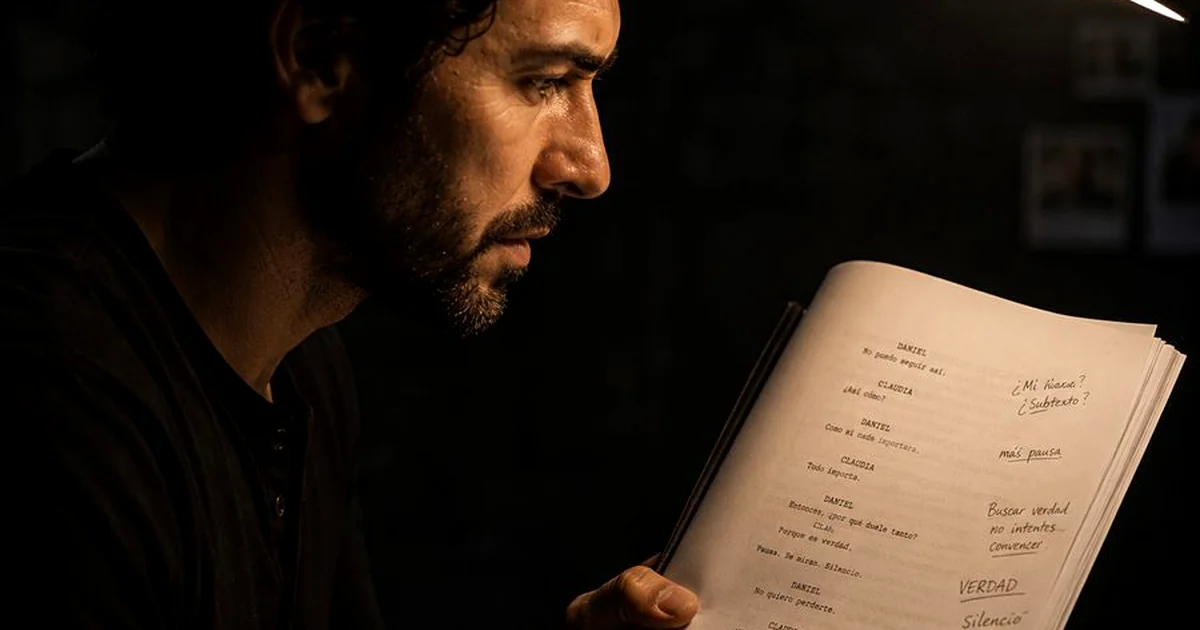
Receiving a script and memorising it is not the same as analysing it. The difference between an actor who repeats words and one who inhabits a character begins exactly here: at the worktable, before standing up, before making a single performance choice. Script analysis is the map that turns text into living action.
This guide walks through the whole process, step by step, with the tools professional actors use to take apart a film, television or theatre script. It doesn't matter whether you've spent years in the profession or are preparing your first important audition: these techniques work because they start from one simple question —what does this character want and why?— and follow it through to its ultimate consequences.
First reading: the state of innocence
Before you underline a single line, read the whole script in one go, at normal speed, without stopping. Do it as a spectator would: letting the story carry you along. This first reading is sacred because you'll never have it again. Your spontaneous reaction —what moves you, what confuses you, what unsettles you— holds valuable information about the emotional world of the text that the later technical analysis may lose sight of.
After this reading, jot down on a piece of paper, without rereading the text, three things: what you feel, what you remember most vividly and what questions you have about your character. These spontaneous notes will be your compass throughout the entire process.
First-reading exercise
Close the script. For five minutes, write without stopping about your character: who they are to you, what catches your attention, what you struggle to understand. Don't censor yourself. This exercise activates intuition before the analytical mind takes control.
The given circumstances: the character's world
Konstantin Stanislavski introduced the concept of given circumstances to denote everything the author offers us as an established fact: the time in which the story takes place, the location, the relationships between characters, the events prior to the action, the social and economic conditions. They are the objective data of the script's universe.
Your job as an actor is to extract them all from the text with a detective's precision. Don't invent what the script doesn't say, but don't ignore what is there either, even if it isn't named explicitly. If the scene takes place in a hospital and your character has spent three hours waiting for news of their child, that is a given circumstance that shapes every word they say.
- When? Era, year, season, time of day, how long the situation has been going on.
- Where? The specific physical space and its atmosphere.
- What happened before? The events immediately preceding the start of the scene.
- Who else is present? The relationships, their history and their emotional charge.
- What is the social context? Class, power, cultural expectations.
Practical exercise: Take a scene from your script and build a sheet with all the given circumstances you can extract from the text. Then mark which are explicit (the author names them) and which are implicit (deduced from context). You'll see that the script gives you far more than it appears to at first glance.
The character's objective: what they want and why
The most fundamental concept in Stanislavskian analysis is the objective (also called the desire, the will or the intention): what the character wants to achieve in the scene, in the act and in the work as a whole. Without an objective there is no action; without action there is no drama.
A well-formulated objective has two essential features. First, it is expressed as a transitive action verb: not "to be sad", but "to get them to forgive me"; not "to feel alone", but "to make them stay". Second, it involves the other character: the objective always points at someone, always aims to produce an effect on another person.
Scene objective vs. super-objective
The scene objective is what the character wants to achieve in that specific scene. The super-objective is the fundamental desire that runs through the entire work, the deepest will that drives the character throughout the whole script. A mother may want, in a specific scene, her son to tell her the truth; but her super-objective may be to protect him at any cost. The tension between these two levels generates the character's complexity.
Exercise: formulating the objective
For every scene in which your character appears, write their objective in this form: "I want to get [name of the other character] to [action verb]". For example: "I want to get María to apologise to me". If the objective is too vague or doesn't involve another character, reformulate it.
Subtext: what goes unsaid
Let casting directors find you
Your talent needs visibility. Create your professional profile on Arga Studios and show up in the searches of those who hire. Free until October 2026.
Create my free profile →Subtext is the current of thought, feeling and intention running beneath the words. What the character says and what they really want to communicate don't always coincide —in fact, in well-written scripts, they rarely do. The gap between text and subtext is the space where real acting lives.
Chekhov built entire plays on this principle: the characters talk about the weather, everyday objects, trivialities, while the emotion they cannot express directly slips between the lines. Pinter took subtext to the extreme: silence itself becomes text. In contemporary cinema, the best screenwriters trust the actor to fill the space between the words.
To find the subtext of a line, ask yourself: why does the character say this instead of saying directly what they want? The reasons can be many: fear, shame, politeness, strategy, protection. Each of those reasons is acting gold.
Subtext exercise
Take a two-page dialogue. In one column, copy the lines exactly as they appear in the script. In the column next to it, write what the character really means in each line. When you read the two texts side by side, you'll have a complete X-ray of the scene's inner life.
Beats and units: dissecting the scene
Stanislavski divided plays into units (sometimes called beats in the Anglo-Saxon tradition): fragments of action that have a beginning, a development and a close. When one of the characters' objectives changes, a beat change occurs. Identifying the beats of a scene is like finding its skeleton: it reveals the power structure and the dynamics of the relationship between the characters.
A beat begins when someone introduces a new objective or when the balance of power between the characters shifts. It can last three lines or three pages. What matters is not the length but the change: something happens that makes the scene turn in a different direction.
- Read the scene and identify the moments where the direction of the action changes.
- Place a mark or a line every time you spot that change.
- For each beat, name your character's objective with an action verb.
- Notice how the beats link together and build the arc of the scene.
Technical note: In English-speaking theatre and film, the term "beat" comes from a mispronunciation of "bit" by Russian students of Stanislavski in America. What began as a misunderstanding became standard terminology. Today both words are used interchangeably depending on context.
The character arc: who they are and who they become
The character arc describes the transformation a character undergoes over the course of the story. Not every character has a pronounced dramatic arc —some are designed precisely to resist change—, but even then, resistance to change is itself a choice you need to understand and play actively.
To map your character's arc, answer these questions in detail:
- Who is your character at the beginning of the story? What do they believe about themselves and about the world?
- What is their fundamental wound or lack? What are they missing, or what do they carry inside that they haven't resolved?
- What do they want (external objective) and what do they need (inner truth they don't yet acknowledge)?
- What key events force them to confront that tension between what they want and what they need?
- How do they emerge transformed —or hardened— at the end?
This map will let you calibrate your character's inner state in every scene. You don't play someone who still doesn't know what they need the same way you play someone who has already glimpsed it but is still resisting.
The emotional through-line: the river running underneath
The technical analysis —objectives, beats, circumstances— is the scaffolding. The emotional through-line is the building. It is the affective state that runs through the character across the whole work, the current of sensations, memories, hopes and fears that shapes how they receive each stimulus and how they respond to it.
A useful tool is to create an emotional score: a scene-by-scene diagram in which you note your character's emotional state at the start of each scene, what transforms it during the scene and how they reach the end. This map lets you see whether the emotional transitions are believable, whether there are moments that require special preparation and where the peaks and valleys of the character's inner journey lie.
Stanislavski insisted that emotion cannot be forced: trying to "feel" sadness or anger directly produces tense, false performances. Instead, if you place the actor in the right circumstances, with the right objective and their attention on the other person, the emotion arises on its own as a result of the action. Script analysis is, ultimately, the process of building those conditions with precision.
Show your work to the world
Create your professional profile on Arga Studios, upload your showreel and access film, theatre and television castings across Spain. Free until October 2026.
Create my free profile →