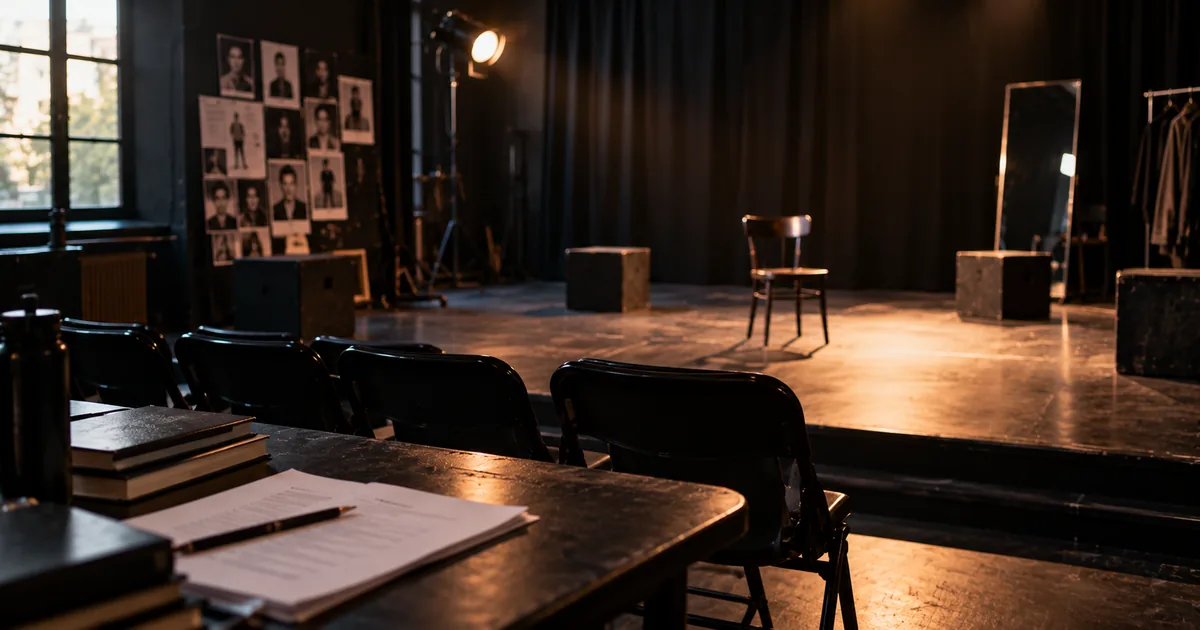
The monologue is the cornerstone of the theatrical audition and one of the formats young actors fear most. Two minutes —sometimes less— in which you must prove not only that you can recite a text, but that you can live through a dramatic situation, build a layered character, manage stage time and hold the audience's attention with no set, no scene partners and no safety net. That demand, properly understood, turns the monologue into the actor's perfect laboratory.
This guide walks through every phase of the process: from choosing the text to the moment you walk into the room, taking in dramaturgical analysis, the character's physical life and the memorization strategies that actually work.
How to choose the right monologue for you
Choosing the text is the most strategic decision in the entire process. A poorly chosen monologue —however brilliantly performed— works against you. A good monologue for you is one that lets you show your range, that lives in your zone of emotional truth and that connects with what the people running the casting you're auditioning for are looking for.
Know your type and your range
Being honest with yourself is not giving up: it's a tool. If you're twenty-five, presenting King Lear's monologue may be a strategic mistake even if you do it well, because the distance between you and the character will become the room's unintended protagonist. Choose texts where the director can picture you in the role. Show what you are now, with all the intensity you can muster, and save the reach of your range for when they ask for it.
Classical vs. contemporary
Drama schools often ask for one classical and one contemporary monologue. Each calls for a different approach:
- Classical (Shakespeare, Calderón, Lope, Molière): language is the score. The musicality of the verse, the rhythm and the rhetorical architecture are an intrinsic part of the character. You can't perform "on top of" the text; you must perform it through the text.
- Contemporary (Pinter, Reza, Mayorga, modern Lorca): subtext is everything. What the character says matters less than what they leave unsaid, what they want and what they fear. Naturalism demands an inner truth that classical verse handles in a different way.
Length: how much time you need
Most auditions ask for between 90 seconds and 3 minutes. Within that range, two minutes fully inhabited are worth more than four minutes well recited. If the text you've chosen is long, cut it. Adapt, don't pad. A monologue that ends while the audience still wants more is a successful monologue.
A practical test: Before committing to a text, ask yourself these questions: Do I viscerally understand what this character wants in this moment? Can I make this genuinely matter to me? Does this text give me the chance to show something specific about my instrument —voice, physicality, comedy, emotional intensity—? If the answer to all three is yes, go for it.
Dramaturgical analysis: the invisible layer that holds everything up
Before you get on your feet to rehearse, sit with the text for hours. Analysis isn't an academic exercise; it's building the internal architecture that will support your performance when the nerves arrive and autopilot takes over.
Objective and super-objective
What does your character want in this particular monologue? That's the scene objective. It must be something active, something you can play: not "I want to feel better", but "I want them to forgive me", "I want to convince them I'm innocent", "I want them to stay". The super-objective is what the character wants across the whole play —their deepest desire—, and the scene objective must connect with it.
Obstacle
All drama is born of the obstacle. What stops the character from getting what they want? The obstacle can be another character (even if not physically present in the monologue), an external circumstance, or the character's own internal conflict. Without an obstacle, the monologue is a speech. With an obstacle, it's a struggle —and struggles are what the audience wants to see.
Tactics
Tactics are the concrete actions the character deploys to overcome the obstacle and reach their objective. They tend to change over the course of the monologue as some fail and the character tries others. Name each tactic with an active transitive verb: persuade, seduce, threaten, beg, reveal, provoke. Each change of tactic is a change of action, and changes of action are the heartbeats of the monologue.
Emotional arc
The character cannot begin and end in the same emotional state. If they start furious and end furious, nothing has happened. Identify the emotional starting point, the turning moments and the final state. That arc —that transformation, however subtle— is what creates the sense that something has truly happened.
The character's physical life
A monologue lives in the body, not just in the mind. The character occupies a space, has a relationship with gravity, a rhythm of movement, a way of breathing. The more specific the physical life, the more believable and present the character will be.
Work these questions from the body, not from theory:
- Where is your character physically? Are they standing, sitting, moving? What have they been doing just before they start to speak?
- Who are they speaking to? Where is that listener in the space? Establish a concrete, specific focal point for the addressee, even if they aren't present in the room.
- What does the character do with their hands? How do they breathe? When do they move and when do they stay still?
- Are there objects on stage —even imaginary ones— that the character interacts with?
Avoid decorative movement: moving because the text "calls for" something emotional, but without any real physical justification. Every movement must have an internal logic. Stillness charged with tension is often more powerful than nervous movement.
A physical-anchoring exercise: Rehearse the monologue completely still —without moving your feet— over several sessions. This forces all of your physical life to concentrate in the gaze, the breath and the small gestures. When you later allow movement again, it will arise from a real need and not from a nervous habit.
A memorization technique that works
Let casting directors find you
Your talent needs visibility. Create your professional profile on Arga Studios and show up in the searches of the people who hire. Free until October 2026.
Create my free profile →Memorizing lines is only the first layer. The real goal is for the text to stop being text and become thought in real time: to look as if the character is thinking those words right now, not reciting them from memory.
Memorize by units of action, not by lines
Break the monologue into small units —fragments that correspond to a specific tactic or emotional state— and learn each one until it's automatic before moving on to the next. This gives you anchor points: if you lose your thread, you know which unit you're in and you can pick up from there.
Work out loud and on the move
Motor memory and verbal memory reinforce each other. Learn the text while walking, gesturing, changing position in the space. Reciting it only in your head builds a fragile kind of memory that shatters under the pressure of the audition.
Practice under degradation
Rehearse the monologue in adverse conditions: tired, after exercising, very quietly, at double speed, with background music. If the text survives the degradation, it's truly learned. If it only works under ideal conditions, it's still fragile.
The last days before the audition
The week before the audition is not the time for radical changes. It's the time to trust the work you've done and to fine-tune the details.
- Ease off the intensity of rehearsal in the two days beforehand. Overworking right before can produce a mechanical, exhausted performance.
- Rehearse in the space, or in a similar space if possible. Change your usual spot so your body doesn't depend on a specific environment.
- Do one or two full run-throughs the day before —no more. The night before, let it rest.
- Think about the character, not the text. Before sleeping, visualize who this character is, what matters to them, what will happen in the room the next day.
In the room: how to make the most of every second
When you walk into the audition room, the monologue has already begun. The first few seconds —how you enter, how you introduce yourself, how you settle in— already say something about you as an actor. Don't waste them.
Take the time you need to prepare before you start. No one is going to rush you. That moment of gathering yourself —reaching the character's state, placing your imaginary listener in the space, feeling the floor under your feet— is visible and conveys professionalism. An actor who launches into speaking before being present tends to look nervous; an actor who takes their time tends to look confident.
When you finish, don't apologize or explain what you "meant to do". Finish the monologue, hold the ending for a moment and close. If the casting director wants to adjust your take, they'll ask you to —and that's a good sign, it means they're interested in you. Your ability to adapt in that moment is often more revealing than the monologue itself.
Your professional profile, always ready
Upload your material, update your card and arrive at every audition with everything in order. Arga Studios is free for actors.
Create my free profile →